Webinar

SHARE THIS

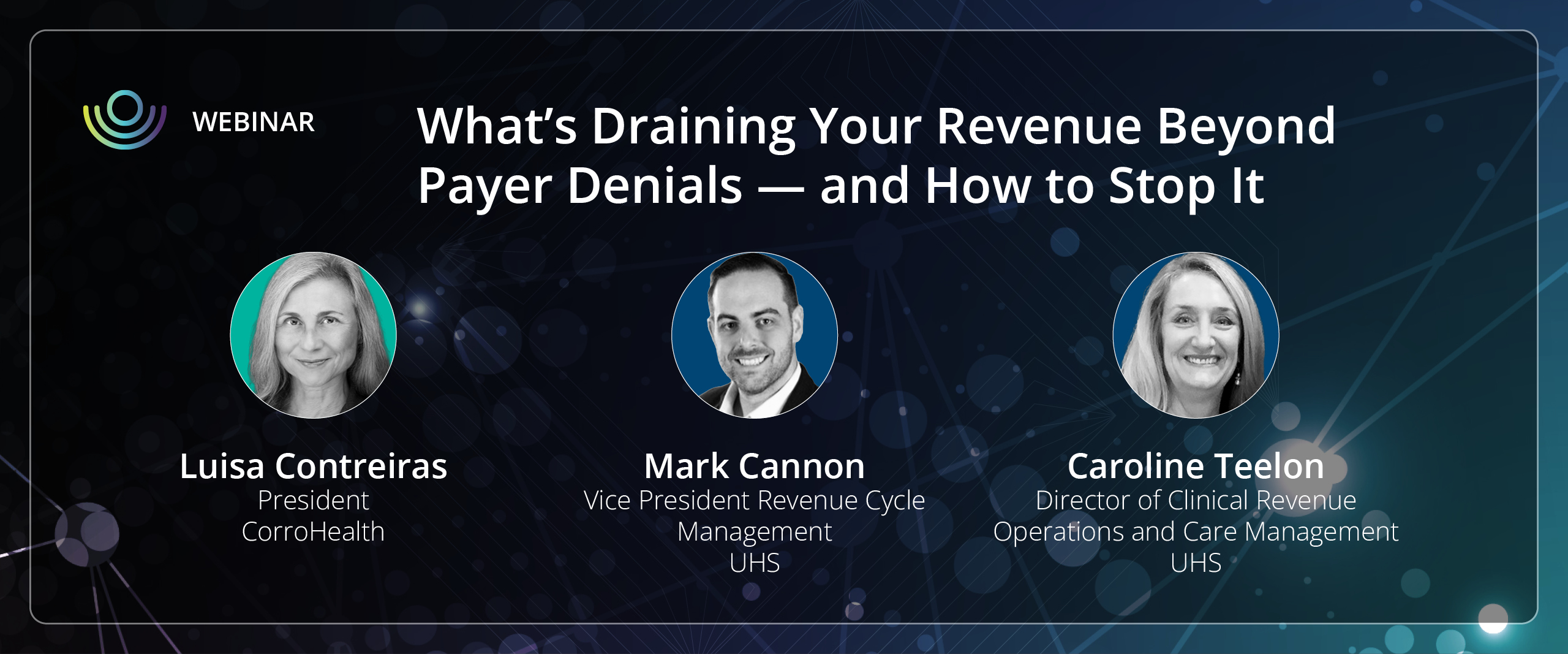
What’s Draining Your Revenue Beyond Payer Denials—and How to Stop It

Wednesday May 6, 2026 at 11:00 AM PST 

Luisa Contreiras

President
CorroHealth

Mark Cannon

Vice President Revenue Cycle Management
UHS

Caroline Teelon

Director of Clinical Revenue Operations and Care Management
UHS
Margins are shrinking. Medicare Advantage is growing. Denials keep climbing. Yet, hospitals continue to write off revenue for care they’ve already delivered. The issue isn’t just payers—it’s also siloed revenue cycle processes and legacy metrics that mask where performance is really breaking down.

In this session, CorroHealth President Luisa Contreiras, UHS Vice President Revenue Cycle Management Mark Cannon, and UHS Director of Clinical Revenue Operations and Care Management Caroline Teelon, will walk through a practical, data‑driven approach that connects clinical decision-making with revenue performance. Attendees will learn how aligning patient access, case management, and revenue cycle teams can meaningfully reduce avoidable revenue leakage. This session will also cover how outcome-focused metrics like Net Inpatient realization (NIR), disciplined application of the Two Midnight Rule, and a structured payer escalation strategy can expose where revenue is being lost and give organizations a clear roadmap for getting paid appropriately for the care they deliver.

Key Takeaways:

  • Understand how shifting from siloed denials management to a revenue-first strategy can stop performance gaps from compounding across the revenue cycle.  
  • Learn how to measure and benchmark against clear revenue goals using modern metrics and identify where current tactics are leaving money on the table.   
  • Walk away with a practical roadmap for holding payers accountable and protecting revenue over the long term.  

More from CorroHealth…

Why Clinical Intelligence Sets AI Apart in Healthcare

Why Clinical Intelligence Sets AI Apart in Healthcare

Why Clinical Intelligence Sets AI Apart in Healthcare Why are DRG downgrades still rising even as AI adoption grows? The answer points to a deeper problem than most AI vendors acknowledge: technology alone does not produce clinical accuracy. Denials keep climbing,...

Everyone Has AI. Few Systems Show Clinical Intelligence.

Everyone Has AI. Few Systems Show Clinical Intelligence.

Everyone Has AI. Few Systems Show Clinical Intelligence.   Thursday, April 2, 2026, 11:00am PT Senior Vice President of Product ManagementClinical Performance SpecialistAI is everywhere in clinical documentation integrity (CDI), but outcomes haven’t always kept pace...

Integrated Teams for Improved Outcomes in Hospital Operations

Integrated Teams for Improved Outcomes in Hospital Operations

Integrated Teams for Improved Outcomes in Hospital OperationsAligning clinical and financial teams in hospitals is now central to effective revenue cycle management. Documentation, coding, and financial outcomes no longer sit in separate operational lanes. Each...

Reimbursement Is Changing. Alignment Will Decide What Works

Reimbursement Is Changing. Alignment Will Decide What Works

Reimbursement Is Changing. Alignment Will Decide What WorksThe future of healthcare reimbursement is being driven less by any single policy and more by mounting pressures across the system. Costs keep rising, administrative complexity remains high, and patients bear...

New CMMI Models Signal a Seismic Shift for Hospitals

New CMMI Models Signal a Seismic Shift for Hospitals

New CMMI Models Signal a Structural Shift for HospitalsThe Centers for Medicare and Medicaid Innovation (CMMI) is reshaping how hospitals are paid, evaluated, and held accountable. The latest generation of payment models extends beyond incremental updates, increasing...

The Documentation Crisis No One Designed for

The Documentation Crisis No One Designed for

The Documentation Crisis No One Designed for – and the Shift That’s Fixing ItClinical documentation was never intended to carry the weight it bears today. At its core, documentation exists to capture clinical reasoning—what a clinician observed, assessed, and...