CASE STUDY

SHARE THIS

Northeast Health System Secured $125M By Partnering with CorroHealth

OVERVIEW  

Northeast Health System is one of the most comprehensive academic health care systems in the country, providing treatment and services to more than three million patients each year. The 11-hospital system resulted from a merger between two health systems.  

THE PROBLEM  

Northeast Health System embraced a traditional outsourced Physician Advisor model using two different vendors. With the consolidation of the two health systems, one of the priorities was implementing consistent processes across the new organization. The Centers for Medicare and Medicaid Services (CMS) implemented the 2-Midnight Rule to address three vulnerabilities:  

  1. reduce inappropriate short inpatient stays,  
  2. reduce inappropriate long observation stays, and  
  3. reduce variability in decision making regarding admission status.  

Consistent with CMS objectives, Northeast Health System’s goal was to increase efficiencies, reduce inappropriate observation rates in line with CMS/OIG guidelines, and eliminate the high degree of variability amongst its eleven hospitals in the application of the CMS 2-Midnight Rule for Traditional Medicare-Fee-For-Service (MFFS) patients. The existing vendors’ solutions were not addressing the inappropriately rising observation rates nor the variability of these rates across the facilities.  

Not satisfied with either of its two vendors and to ensure best in class compliance and revenue integrity, Northeast Health System leadership engaged CorroHealth.  

THE SOLUTION  

Northeast Health System partnered with CorroHealth to perform a Clinical Revenue Cycle Opportunity Assessment to assess variability in the application of the CMS 2-Midnight Rule and identify if there was overuse of inappropriate long observation.  

After performing the Assessment, CorroHealth showed that implementing a 2-Midnight Rule compliant approach would enable a revenue integrity opportunity of $17 million. This also reduces the statusing variability, and an over usage of the inpatient status for short stay cases. The approach would align the system’s performance with CMS and the Office of Inspector General (OIG) guidelines under the 2-Midnight Rule.  

Based on this Assessment, Northeast Health System decided to implement the CorroHealth 2- Midnight Rule Program as a pilot at four facilities in early 2019. After only three months of the pilot, Northeast Health System leadership decided to roll-out the program to the other seven hospitals, given the immediate operational, compliance, and financial improvements.  

RESULTS  

During the Assessment, CorroHealth identified revenue opportunities and compliance risks for all Northeast Health System sites. CorroHealth then utilized this information to implement targeted process recommendations and workflow modifications for Utilization Management and physician staff.  

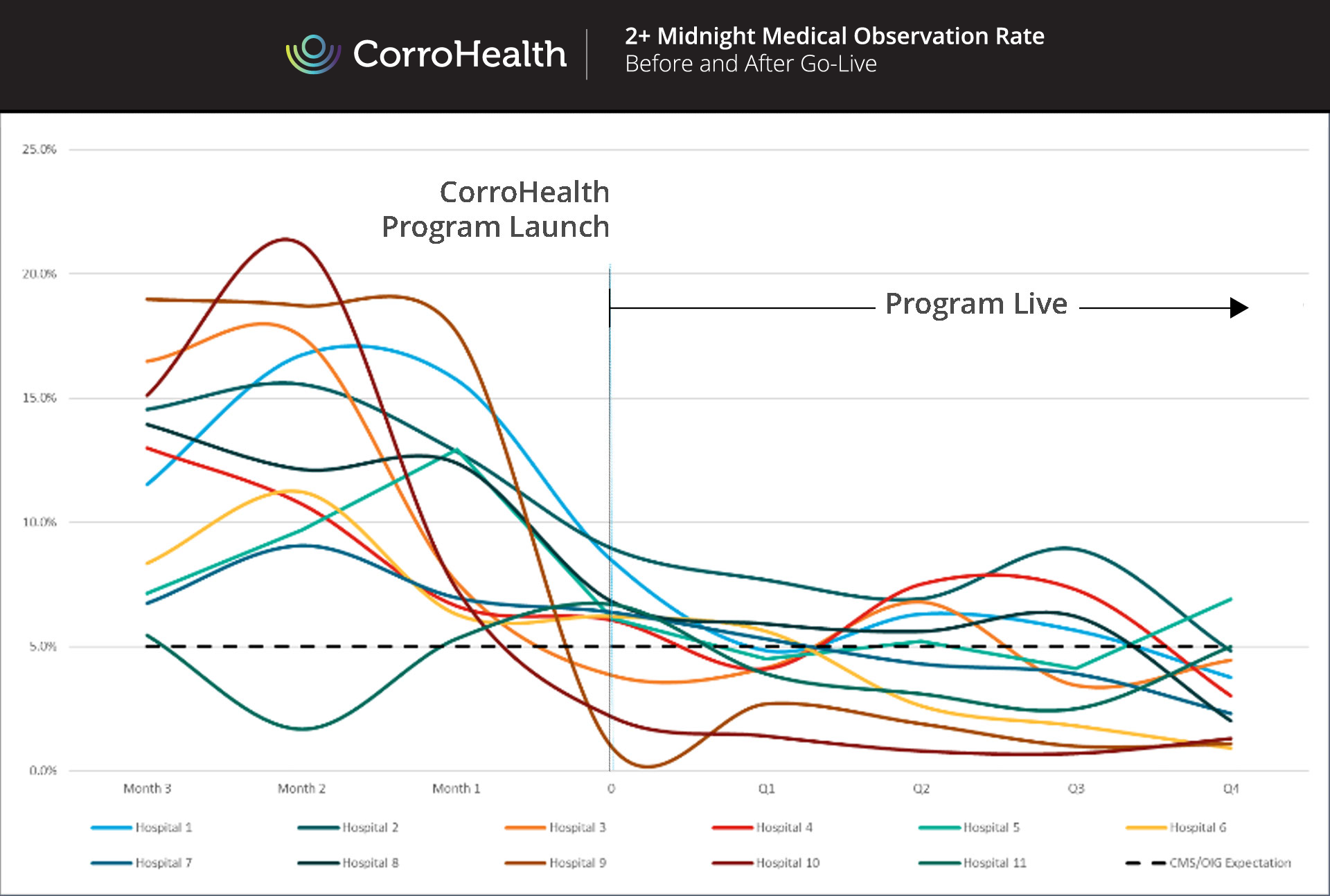
Graph 1 below shows the CorroHealth program’s impact on inappropriate long-stay Observation Rates for every Northeast Health System facility across an eight-month timeframe in 2019. 

CorroHealth appointed a Strategic Advisor to identify opportunities and implement a streamlined, complaint process. Leveraging data, trends, and audits, CorroHealth continuously measures monthly adherence to the 2-Midnight Rule. This helps identify and report on variant cases and processes. CorroHealth and Northeast Health System collaborate to implement processes modifications and targeted education, addressing outliers. 

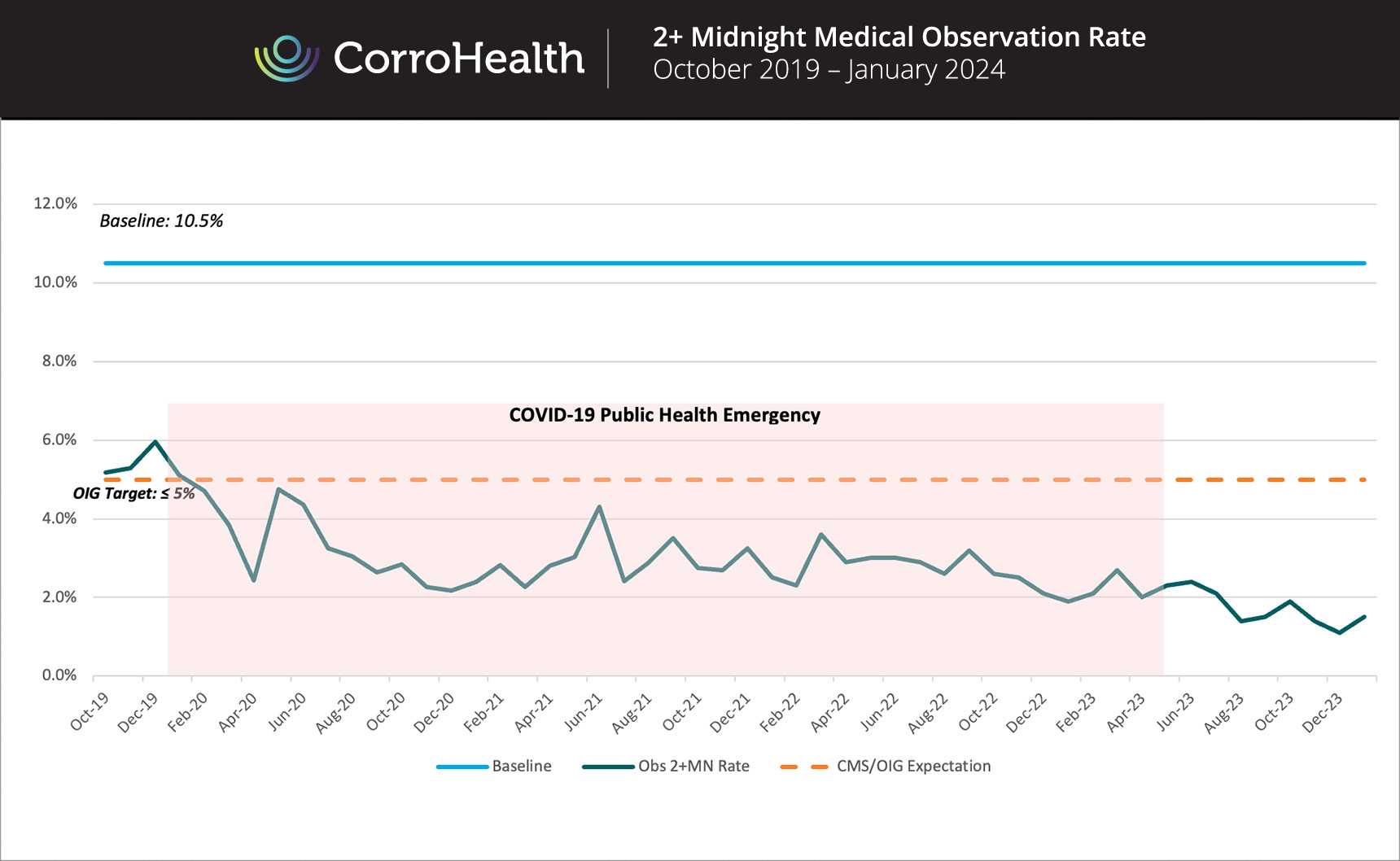
Case in point: In August 2019 (Q2 in Graph 1 above), the Strategic Advisor noticed an increase in the inappropriate long-stay observation rate at Hospital 4. The Strategic Advisor and senior leadership met and discovered an operational gap in case reviews—a case manager was not following CMS 2-Midnight Rule process, and some cases were not being reviewed. The good news: the issue was identified and resolved within two months. The outcome: Hospital 4’s observation rate has remained within the CMS/OIG expected range since CorroHealth provided additional education. The observation rate for the other 10 hospitals has remained below the target rate since January 2020, and the program has remained sustainable through January 2024, despite the disruption and impact of the COVID-19 pandemic.  

By implementing a consistent and compliant process for the 2-Midnight Rule across all 11 facilities, Northeast Health System has recognized a positive net financial impact of over $125M in appropriate incremental revenue since program inception and a program-to-date long-stay observation rate as low as 3.1%, down from a blended 10.5% before the start of the CorroHealth partnership. Graph 2 below demonstrates the program’s impact from its go-live date in October 2019 through January 2024. 

Note: Program Go-Live completed in Oct 2019 

CorroHealth successfully translated Northeast Health System’s data into actionable insights—despite a worldwide health crisis—and continues to help the system realize additional revenue opportunities, mitigate risks, and monitor results to ensure Medicare Fee-for-Service revenue. 

Whether you want to learn more or you are ready to get started, let’s talk.

Build a Stronger Bottom Line with our Hospital Budgeting Toolkit

Build a Stronger Bottom Line with our Hospital Budgeting Toolkit

Build a Stronger Bottom Line with our Hospital Budgeting Toolkit Budget season can put health system leaders in a difficult spot. Costs must come down and every dollar has to be justified. But with denials rising, payer demands intensifying, and patient needs growing...

Stronger Documentation, Smarter Revenue: The UM & CDI Advantage

Stronger Documentation, Smarter Revenue: The UM & CDI Advantage

Stronger Documentation, Smarter Revenue The UM & CDI Advantage March 11th | 11:00 AM PST  |  Becker's Hospital ReviewChief Medical OfficerCorroHealthSenior Vice PresidentCorroHealthAs hospitals face increasing financial pressures and growing payer scrutiny,...

The $23.5 Million Difference in Patient Status Determinations

The $23.5 Million Difference in Patient Status Determinations

The $23.5 Million Difference in Patient Status DeterminationsHow One Strategic Partnership Catalyzed Hospital Utilization Management Strategies and Revenue Growth Overview A top-tier nonprofit health system in Southwest Florida is ranked among the top 15% of hospitals...

How Improved RAF Accuracy Unlocked $12M in Revenue

How Improved RAF Accuracy Unlocked $12M in Revenue

How CoxHealth and CorroHealth Improved RAF Accuracy, Unlocked $12M in Revenue, and Enhanced Value-Based Care Accurate Risk Adjustment Factor (RAF) scores aren't just numbers, they directly impact care quality, resource allocation, and financial success for healthcare...

The Limitations of CMI as a KPI

The Limitations of CMI as a KPI

How well do you understand your hospital’s Case Mix Index (CMI) and its impact on hospital performance? Uncover the factors influencing this popular healthcare metric. Listen to Managing Director of Strategic Advisor Services Sam Dominik explain more…

More from CorroHealth

Build a Stronger Bottom Line with our Hospital Budgeting Toolkit

Build a Stronger Bottom Line with our Hospital Budgeting Toolkit

Build a Stronger Bottom Line with our Hospital Budgeting Toolkit Budget season can put health system leaders in a difficult spot. Costs must come down and every dollar has to be justified. But with denials rising, payer demands intensifying, and patient needs growing...